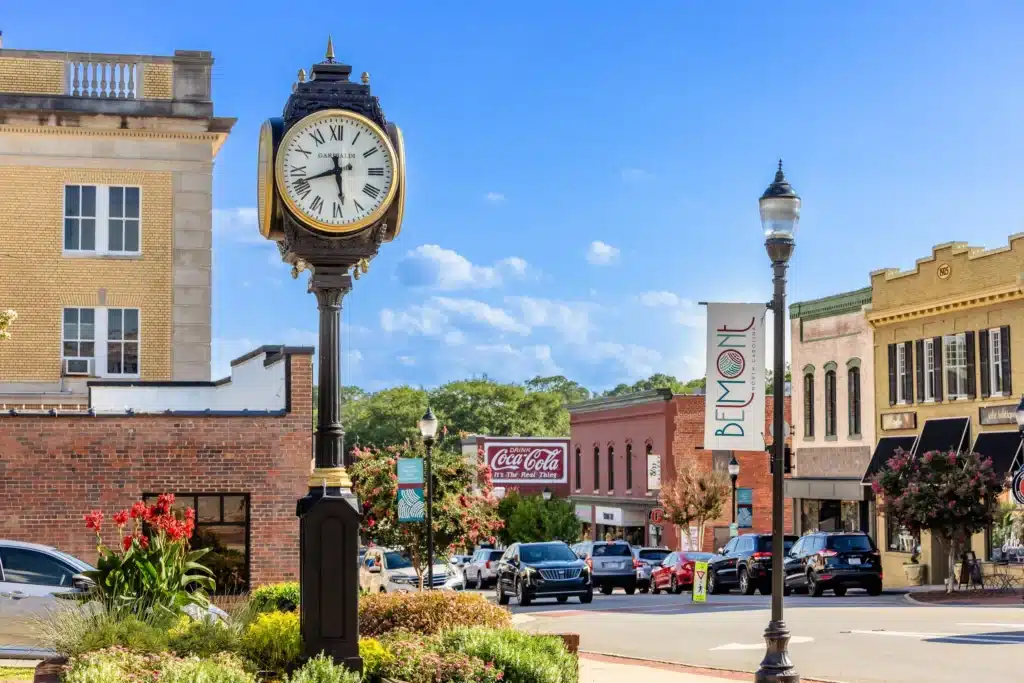
Belmont looks like a Charlotte suburb on a listing map. The tax card says otherwise. The city sits in Gaston County, on a peninsula between the Catawba and the South Fork, with a rebuilt Main Street and Belmont Abbey College a few blocks from older houses and new townhomes. Mecklenburg’s 2027 revaluation does not touch a Belmont parcel. Gaston’s most recent reappraisal was 2023, and the county keeps its own schedule.
We work out of Uptown Charlotte, 128 South Tryon Street (suite 1933), as a North Carolina mortgage broker (Company NMLS 2468711). You apply once. Wholesale lenders then get priced so a Main Street townhome, an Abbey-area house and a Lake Wylie lot each find an investor that actually wants that collateral.
This is Gaston County, even when the commute feels like Charlotte
Buyers who work at the airport or in west Charlotte often treat Belmont as an extension of Mecklenburg. Underwriters and tax offices do not. The tax record lists Gaston as the county. School assignment follows Gaston County Schools. The 2027 Mecklenburg reset that shoppers hear about in Matthews or Huntersville does not apply here. That single fact changes how we estimate escrow and how we talk about next year’s payment.
The trade is the point. You leave Mecklenburg pricing behind and pick up a shorter run to Charlotte Douglas International Airport, plus a drive of about 15 minutes to Uptown on I-85. Frequent travelers and airport employees look here for that reason. So do people who want Lake Wylie without crossing into South Carolina.
A small city that prices above the rest of Gaston
Census Reporter’s reading of the 2020-2024 ACS puts 15,546 people in Belmont. About 71 percent of households own. Owners’ homes have a midpoint value of $395,000, well above Gaston County’s $266,000. Household income centers on $94,883, compared with $67,478 countywide. In other words, Belmont is the expensive corner of a more affordable county, not a bargain version of south Charlotte.
The midpoint construction year is 2002, twenty years newer than Gaston’s 1982 midpoint. Detached houses make up 73 percent of homes. Roughly 74 percent of owners still have financing in place. The median tax owners reported paying is $3,702, far above the county’s $1,982 midpoint and the first hint that the city levy matters here. Typical gross rent sits at $1,365. The Census midpoint for move-in year is 2014.
Four Belmont settings that change the file
Downtown mixes older houses with new townhomes near Main Street. Character is the draw. Age and HOA documents are the financing details. Inspect the systems on the older houses, and put association dues into qualifying on the townhomes before you write the offer.
South Point and the Lake Wylie shoreline live in a higher price band. Some waterfront and lake-access sales need financing above FHFA’s 2026 conforming ceiling of $832,750 and become a jumbo conversation. Flood questions show up along the water, and they should be resolved before you treat a quoted payment as final.
Newer subdivisions off NC 273 and South New Hope Road are planned communities with HOAs. Amenities and dues vary by street. Near Belmont Abbey College the houses are more established, with demand that does not depend on a brand-new amenity package. If you are also weighing the next city west, our Gastonia purchase page and the Mount Holly guide cover those markets separately.
What Gaston's listings say, and what they do not
Realtor.com counted 1,078 Gaston County actives in September 2026, 7 percent more than a year earlier. That month added 392 fresh listings and 446 pendings, and about 26 percent of sellers had already cut the ask. Those are county figures. They describe a market with room to negotiate, not a promise about a South Point pier lot or a Main Street townhome.
A single-family property in this market can use conforming financing as high as FHFA’s 2026 cap of $832,750, or FHA as high as HUD’s $541,287 ceiling. Belmont’s $395,000 median owner value sits comfortably inside both caps. Shoreline sales are the files that bump into the conforming ceiling.
A combined rate of $1.0540, and an 87 percent sales ratio
Gaston County levies 59.9 cents and the City of Belmont adds 45.5 cents, a published 2026-27 total of $1.0540 on each $100 of value. On a $350,000 assessment that is about $3,689 for the year. On $400,000 it is about $4,216. DOR published those 2026-27 rates. Compared with many Mecklenburg towns, the rate looks high. Compared with the rest of Gaston, the bills look high because values here are high.
The state’s reported ratio of assessed value to recent sales in Gaston County is about 87 percent, meaning typical tax values sit below recent sale prices. Gaston last reappraised in 2023. The next countywide reappraisal, whenever it is scheduled, is likely to lift many assessments toward the market. Do not build escrow as if the card will stay put forever.
How North Carolina bills and prorates a calendar-year tax is covered on our metro tax explainer. What is local here is whether the parcel carries Belmont’s 45.5-cent city levy; a lot just outside town drops that piece.
Rivers, flood maps and the checks that belong in due diligence
A peninsula between two rivers is a beautiful place to live and a specific place to insure. Before you commit, look up the flood zone on lots near the Catawba or the South Fork. Required flood coverage gets added to the qualifying payment. Check city limits at the same time, and ask for HOA rules in the newer planned communities off NC 273 and South New Hope Road.
Most Belmont contracts follow the standard North Carolina purchase form. Our purchase guide explains deposits, attorney closings and the state’s deed excise. What is local here is the flood check along either river and confirmation that the lot sits inside city limits.
Loan paths that show up on Belmont files
Conventional financing handles most in-town resale homes. FHA remains useful when down payment or credit points that way, and the $541,287 FHA ceiling is well above the city’s median owner value. Eligible veterans should compare VA financing. USDA is a question for more rural Gaston addresses, not for a typical Main Street or South Point house; see USDA maps near Charlotte if you are looking west of town. Jumbo appears on the water. Self-employed buyers can document income with bank statements, and investors can price DSCR options, when tax returns are not the cleanest story.
When cash at signing is tight, some wholesale channels attach their own help, often a junior lien beside an FHA first mortgage, written off after a published occupancy period or repaid, and occasionally a grant that travels with a conventional first mortgage. They originate with lenders. We always show an unassisted quote beside the helped one, because a lower cash-to-close number can hide a richer note rate.
Dropping Belmont's 45.5-cent city piece changes a $395,000 card by about $1,797 a year
Inside Belmont the published 2026-27 stack is $1.0540, Gaston’s 59.9 cents plus the city’s 45.5 cents. On the ACS owner midpoint of $395,000, that stack comes to roughly $4,163 for the year, which is about $347 each month. Cross the city line and only Gaston’s 59.9 cents remain, so the same $395,000 of assessed value would owe roughly $2,366 for the year, about $197 each month. Belmont’s 45.5-cent levy is the entire difference: about $1,797 at the midpoint and about $1,820 once the card shows $400,000.
The ACS tax midpoint for Belmont owners is $3,702. That sits next to the $3,689 we already show on a $350,000 in-city assessment, and below the $4,163 arithmetic on a $395,000 card at $1.0540. One number is a survey response. The other is rate times assessed value on the current Gaston card, with the city levy added only when the lot is inside Belmont.
Belmont’s owner midpoint of $395,000 is about $129,000 higher than Gaston County’s $266,000. Gaston County’s ACS tax midpoint is $1,982, which behaves more like the $2,366 outside-city example than like an in-city Belmont worksheet. A Charlotte pairing of $0.7857, used only as a comparison, would collect about $3,143 on a $400,000 assessment. Belmont would collect about $4,216 on that same assessed amount, roughly $1,073 more, because Gaston’s 59.9 cents and Belmont’s 45.5 cents add up to more than Mecklenburg’s published city-and-county combination.
South Point is where the $395,000 midpoint stops describing the file
Take HUD’s 2026 FHA maximum of $541,287 and subtract Belmont’s $395,000 owner midpoint: about $146,287 remains before a contract would outgrow FHA on price. Houses near Main Street, around Belmont Abbey College, and in the planned streets off NC 273 and South New Hope Road typically live in that band, and they also typically stay under FHFA’s $832,750 conforming ceiling. South Point and the Lake Wylie shoreline are the exceptions. Waterfront and lake-access sales can need a loan larger than $832,750, which moves the file into jumbo territory and often adds a flood review.
About 74 percent of Belmont owners still carry financing. Detached houses account for 73 percent of the stock. Household income centers on $94,883, roughly $27,405 above the Gaston County midpoint of $67,478. Most Belmont houses were built around 2002, two decades after Gaston’s 1982 midpoint. In-town resales often price as conventional files even when FHA could still cover the contract. That is a credit-and-cash decision, not a ceiling decision, until the lot sits on the water.
If the in-city $1.0540 stack were applied to a $541,287 assessment, yearly tax would be about $5,705, or about $475 a month. On an $832,750 assessment the same stack would be about $8,777, or about $731 a month. A South Point pier lot is where those larger illustrations start to matter; an Abbey-area house usually does not need them.
How we take a Belmont purchase from the first call to recording
We start by naming the part of Belmont you want, downtown, a planned street off NC 273, the Abbey area or the lake, and monthly numbers that already include the $1.0540 city-and-county total when the lot sits inside Belmont. After we review income, reserves and credit we send a letter that can survive a listing agent’s questions.
After your offer is accepted we pick a wholesale channel, schedule the appraisal (waterfront homes need extra attention) and decide when a lock makes sense. Federal rules then deliver the Closing Disclosure with its required reading window, then the attorney records the deed in Gaston County.
Wider county context is on our Gaston County page. Owners who want to change an existing loan can begin with the Charlotte refinance overview.
What Belmont-area clients have shared
The comments below arrive through our Google review feed and appear as they were written.
Agencies behind the Belmont numbers
Census Reporter assembled the 2020-2024 ACS figures used here: 15,546 residents, a $395,000 midpoint owner value, income of $94,883, 71 percent ownership, a 2002 midpoint year built, the detached and mortgage shares, taxes paid, rent and the 2014 move-in midpoint. Realtor.com supplied Gaston County’s September 2026 inventory (1,078 actives, up 7 percent; 392 new listings; 446 pendings; about 26 percent already reduced). FHFA and HUD set the 2026 loan caps. DOR published the $1.0540 2026-27 total (59.9 cents county, 45.5 cents city), the 2023 Gaston reappraisal, and the roughly 87 percent ratio of assessed value to recent sales. The $3,689 and $4,216 illustrations use $350,000 and $400,000 of assessed value. The prior version of this page described the Uptown drive as about 15 minutes on I-85. We cite these publishers as public references.
Building a Belmont payment without copying last year's coupon
On a $400,000 city assessment, the $1.0540 stack produces about $4,216 a year before any exemption. Layer in a homeowners quote for the specific address, planned-community dues when they apply, and flood coverage when either river requires it. Because Gaston’s published ratio of tax value to recent sales is about 87 percent, a later reappraisal can move the escrow number even if the city rate stays put.
See also our notes on metro property taxes, insurance in both Carolinas and closing costs.
At Belmont’s $395,000 owner midpoint, the in-city $1.0540 stack is about $4,163 a year, or about $347 a month. Just outside the city, Gaston’s 59.9 cents alone are about $2,366 a year, or about $197 a month. A $541,287 in-city assessment would owe about $5,705 a year, or about $475 a month. An $832,750 in-city assessment would owe about $8,777 a year, or about $731 a month.
Belmont owners who want to tap equity
Owners along the lake or near downtown sometimes want cash for updates or for another purchase without touching a first mortgage they like. Compare a revolving line against a cash-out second and against refinancing the existing loan; each solves a different version of that problem. Compare them on the Charlotte HELOC guide before you give up a rate you are happy with. Buying again before this house sells is covered on the bridge financing page.
1st Advantage Mortgage Broker LLC is a Mortgage Broker, not a lender. Company NMLS #2468711 (NMLS Consumer Access), licensed as a mortgage broker by the North Carolina Commissioner of Banks. Equal Housing Opportunity. 1st Advantage Mortgage is not a government agency and is not affiliated with HUD, FHA, VA, USDA or any city or county. This page is general information, not an offer or commitment to lend. All loans are subject to credit approval, property appraisal and program eligibility, and program availability can change. Local statistics are estimates from the sources listed.