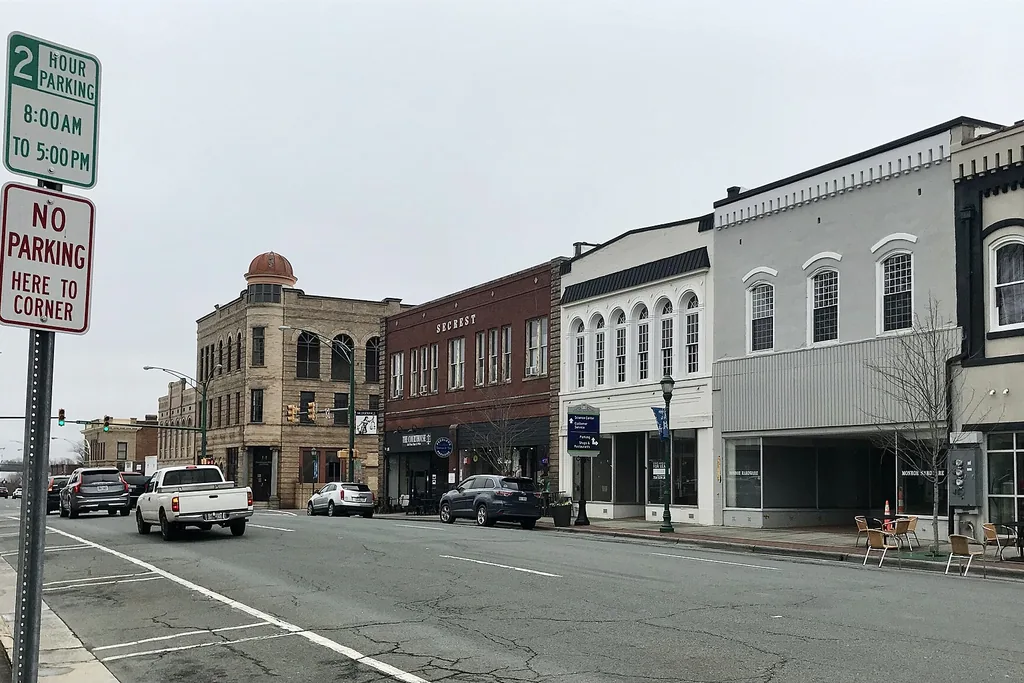
Monroe is where Union County keeps its courthouse, and it is also where the county’s prices come back down to earth. Census Reporter’s take on the 2020-2024 ACS places the midpoint owner-occupied home at $309,100. Across Union County the same measure is $417,300. Household income centers on $72,540 here versus $102,900 countywide. About 62 percent of households own, well below the county’s 82 percent, which is why so many of the people who call us from Monroe are leaving a rental or purchasing a first home.
We work from our Uptown desk at 128 S. Tryon, #1933, as a North Carolina mortgage broker (Company NMLS 2468711). You complete one application. Wholesale lenders then see that file, whether the house sits by the old courthouse, west of downtown on a larger mid-century lot, in a newer pocket along the Monroe Expressway, or on a rural acreage in eastern Union County.
The county seat that still costs less than its own county
Buyers shopping Waxhaw, Marvin or the Union County side of Weddington often treat Monroe as a backup. The numbers say it is a different market. Union County’s September 2026 midpoint ask sat at $527,450, 4.1 percent below the prior September, and listings typically needed 63 days, according to Realtor.com. Monroe’s own owner-value midpoint of $309,100 sits far below that county asking-price snapshot. A Monroe purchase is not the same product as the typical Union County house. You are buying the affordable seat of a wealthy county.
Census Reporter counts 36,759 residents in the city against 250,958 in Union County. The midpoint Monroe house dates to 1989, more than a decade older than the county’s 2000 midpoint. Stand-alone houses account for 71 percent of homes, compared with 86 percent countywide. About 70 percent of owners still finance the house, matching the county share. Owners listed a midpoint property tax of $1,994, under Union’s $2,396, another sign that values, not just rates, shape the bill. Renters typically pay about $1,246 in gross rent. Census data put the typical owner arrival at 2013.
Courthouse blocks, the Expressway, and the rural east
Downtown gathers older houses and smaller homes around the historic courthouse square. Character is the reason people look there. Age is the underwriting detail. Roof, wiring, plumbing and foundation deserve a hard look during due diligence, especially if you hope to use FHA or VA financing, which treat safety items more strictly than a conventional investor might.
West of downtown, mid-century streets often come with more land and fewer association rules. Newer subdivisions along the Monroe Expressway are a different product: builder incentives show up often, HOA documents matter, and the commute toward Charlotte runs on a toll road that parallels the US 74 corridor rather than replacing it. US 74 itself remains the free route. The Charlotte-Monroe Executive Airport sits on this side of the county and is part of how the east end of town is laid out.
Eastern Union County still reads as rural. Some of those addresses qualify for USDA financing if the buyer also meets income rules. Most in-town streets do not. Eligibility follows the land, so the mailing city is not the test. Nearby Union County markets are discussed on our Indian Trail page and the Union County guide.
A 2025 reset that brought tax cards close to the market
Inside the city the published 2026-27 total is $0.8742 against each $100 of value, assembled from Union County’s $0.4342 and Monroe’s 44-cent municipal levy. Each $100,000 increment of assessed value adds roughly $874 to the yearly bill. On a $400,000 tax value the city-and-county piece comes to about $3,497. NCDOR published that stack for 2026-27. A parcel beyond the municipal line loses the 44-cent city piece, which is why we confirm the boundary before we quote escrow.
Union County last reappraised in 2025. After that reset, assessed values sit close to recent selling prices. Published figures put tax values at about 98 percent of recent selling prices, so last year’s tax coupon is a much closer escrow starting point here than in a county still awaiting a reset. How North Carolina bills a calendar year and prorates at closing is laid out on our metro tax page. The Monroe-specific piece is that 2025 reset and the question of whether the parcel carries Monroe’s city levy.
Some Union County parcels also pick up fire or special-district charges. Those extras live on the tax card rather than in the basic city-and-county stack. We read the card rather than assuming every Monroe mailing address shares one bill.
A city that runs its own power, water and gas
The City of Monroe runs its own electric, water and gas utilities. That is unusual even among the towns we serve, and it changes the monthly picture in a way a generic insurance-and-tax estimate will miss. Ask the seller for recent bills covering all three services before you treat a quoted payment as the full monthly picture. Usage on an older 1989-era house can look very different from usage in a new Expressway subdivision.
Confirm at the same time whether the home sits inside city limits or in unincorporated Union County. The mailing city can say Monroe while the tax record and the utility provider tell another story. Inside town you are budgeting for city utilities and the 44-cent levy. Outside town you may be on a different electric cooperative or well-and-septic setup, and the loan options can change with them.
How Monroe purchases typically get financed
Most in-town resale files use conventional or FHA financing. Monroe’s $309,100 owner midpoint sits well inside the 2026 caps posted on our conventional and FHA pages, so program choice here is about credit, cash and the condition of an older house, not about bumping a limit. Veterans who qualify should weigh VA financing. Jumbo rarely appears at these values. Self-employed borrowers can use bank-statement documentation when tax returns undersell the story.
When cash at the table is the constraint, some wholesale channels add their own assistance. That help is typically a second mortgage next to an FHA first, later written off or repaid, and in a few channels a grant that sits beside a conventional loan. We quote the file both with and without that help, because a smaller check at signing can conceal a higher note rate.
Monroe's 44-cent city levy adds about $1,360 a year at the $309,100 midpoint
The published 2026-27 Monroe stack is $0.8742: Union’s $0.4342 plus 44 city cents. On the $309,100 owner midpoint that stack comes to roughly $2,702 yearly, about $225 each month. If the parcel sits beyond the municipal line, only Union’s $0.4342 remains, so the same $309,100 would owe roughly $1,342 yearly, about $112 each month. Monroe’s 44-cent levy is the difference, about $1,360 at the midpoint and about $1,760 when assessed value reaches $400,000.
Union’s 2025 countywide reset left assessed values near 98 percent of recent selling prices, according to DOR. A current coupon is therefore a stronger first draft here than in a county whose cards still lag. Fire or special-district lines can still appear above that basic stack, so the individual card matters more than the mailing city.
Monroe owners reported paying about $1,994, below Union County’s $2,396 and below the $2,702 midpoint worksheet. One amount came from the ACS survey. The other is $0.8742 times an in-city assessed value of $309,100. Together they show that Monroe bills track lower values more than they track a bargain rate.
The $309,100 midpoint leaves about $232,187 under FHA, with three city-run utilities beside the note
Take $541,287 minus $309,100 and about $232,187 of FHA capacity remains. The $832,750 conforming ceiling is farther still. Caps rarely pick the program in Monroe. An older house near the courthouse square or on a mid-century west-side lot is more likely to turn on roof, wiring and plumbing, particularly when FHA or VA will treat safety items strictly. Expressway-area phases more often turn on HOA dues and written builder credits. Rural land east of town is where a USDA map check belongs.
Union County’s owner midpoint is $417,300, about $108,200 above Monroe’s $309,100. The county’s September 2026 listing midpoint of $527,450 sits about $218,350 above the city figure. Typical household income of $72,540 is about $30,360 below the county’s $102,900. Ownership is about 62 percent in the city and 82 percent across Union County. Those gaps are why callers here are often leaving a rental or buying a first house, rather than treating Monroe as a fallback after shopping Waxhaw or Marvin.
Monroe also sells residents their electric, water and gas. Seeing recent statements for all three keeps the quoted payment honest, because a 1989 house and a new Expressway house do not use those services the same way. For scale, $0.8742 on $541,287 would be about $4,732 yearly, near $394 monthly, and on $832,750 it would be about $7,280 yearly, near $607 monthly. Those ceiling cases rarely match a Monroe contract. An unread utility stack is the more common surprise.
From the first conversation to a Union County recording
We begin by identifying which Monroe you actually want (courthouse streets, a mid-century lot west of downtown, a new phase along the Expressway, or rural acreage) and a monthly number that already includes the $0.8742 city total whenever the lot sits inside the city. Recent utility bills belong in that conversation. Once pay, assets and the credit report check out, we issue a letter a listing agent can trust.
Deposits, attorney closings and deed excise follow the statewide pattern in our purchase guide. What changes on a Monroe file is the inspection timeline on a 1989 house, the city-limit check, and the USDA map question east of town. When the contract is signed we select an investor, order the appraisal and decide when to lock. The attorney you choose records the deed at the Union County office.
Current Monroe owners looking at a new rate or term can use the Charlotte-area refinance overview.
What Monroe-area clients have written
Google reviews below appear the way clients wrote them.
Who published the Monroe numbers
Census Reporter compiled the 2020-2024 ACS readings used here: 36,759 residents, income of $72,540, 62 percent ownership, a $309,100 owner-value midpoint, the 1989 midpoint year built, detached and mortgage shares, the $1,994 tax owners reported, rent of $1,246 and a 2013 arrival midpoint, each set beside the matching Union County figure. Realtor.com reported Union County’s September 2026 midpoint ask of $527,450 (down 4.1 percent), a 63-day typical listing, 950 actives (about 5 percent above the prior September), 324 new listings, 426 pendings and roughly 26 percent of sellers already cutting the ask. DOR’s 2026-27 tables list the $0.8742 in-city total (Union $0.4342 plus Monroe’s 44 cents) and name 2025 as Union’s latest reappraisal year; that office also reports assessed values running near 98 percent of recent selling prices after that reset. City-run electric, water and gas service, the Expressway as a toll road parallel to US 74, Union County Public Schools and the Charlotte-Monroe Executive Airport were already stated on the previous edition of this page.
What a Monroe payment actually includes
On $400,000 of in-city assessed value, the $0.8742 stack produces about $3,497 for the year. Many Monroe purchases sit closer to the $309,100 owner midpoint, so the yearly tax is often smaller even though the rate is not cheap. Add the three city utilities, a homeowners quote written for that address, and association dues if you land in a new Expressway subdivision. Creek-side lots in eastern Union deserve a flood-zone check on FEMA’s map for the parcel. Insurance pricing for both Carolinas is collected on our insurance page.
Using Monroe’s $309,100 owner midpoint, $0.8742 produces about $2,702 yearly, near $225 monthly. Using only Union’s $0.4342, the yearly amount is about $1,342, near $112 monthly. On $541,287 the in-city stack would be about $4,732 yearly, near $394 monthly. On $832,750 it would be about $7,280 yearly, near $607 monthly.
If you already own in Monroe
Union County’s 2025 reappraisal brought many tax cards close to the market, which is useful context if you are deciding whether to borrow against equity. A line of credit or a closed-end second can leave the first mortgage untouched; compare those paths in the Charlotte HELOC guide. If the next purchase cannot wait for this sale to finish, that is a bridge-financing conversation.
1st Advantage Mortgage Broker LLC is a Mortgage Broker, not a lender. Company NMLS #2468711 (NMLS Consumer Access), licensed as a mortgage broker by the North Carolina Commissioner of Banks. Equal Housing Opportunity. 1st Advantage Mortgage is not a government agency and is not affiliated with HUD, FHA, VA, USDA or any city or county. This page is general information, not an offer or commitment to lend. All loans are subject to credit approval, property appraisal and program eligibility, and program availability can change. Local statistics are estimates from the sources listed.