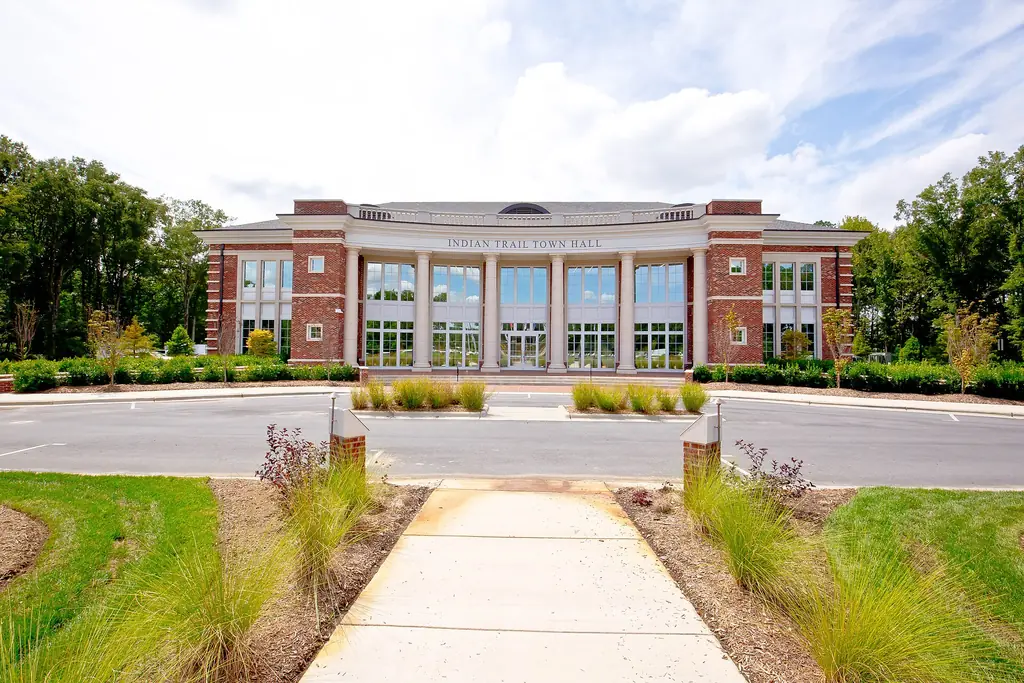
People who already rent in Indian Trail often call us after they stack a proposed house payment against the rent they pay now. The 2020-2024 American Community Survey compiled by Census Reporter puts typical gross rent at $2,077, far above Union County’s $1,496. Typical owned homes here are valued at $385,000, under the county’s $417,300, and household income centers on $108,483, a bit above the county’s $102,900. About 78 percent of households own. The town itself is not trying to win on raw price. It wins when a moderate value meets an unusually small municipal tax.
We work from Suite 1933 at 128 S Tryon St in Charlotte as a North Carolina mortgage broker (Company NMLS 2468711). You fill out one application. Wholesale desks then review that application, whether you are looking in Sun Valley, in Brandon Oaks or Bonterra, in a newer phase south of US 74, or on a lot so close to Matthews that the tax jurisdiction has to be proven before anyone quotes escrow.
When local rent already looks like a house payment
That $2,077 rent midpoint is the figure many first-time buyers in town use as their yardstick. Once you add principal, interest, a realistic dues estimate and Indian Trail’s published tax stack, the monthly number can land closer to current rent than people expect. It can also jump if you pick an amenity community whose dues were not in the first napkin math.
Census Reporter counts 42,036 people in Indian Trail. Union County overall has 250,958 residents. The typical house dates to 2004, a few years newer than Union County’s midpoint of 2000. Eighty-nine percent of homes are detached, a bit above Union’s 86 percent share. Roughly 77 percent of owners here still carry financing, versus 70 percent countywide. Owners reported paying taxes that center on $2,258, under Union’s $2,396. The midpoint year owners moved in is 2013.
Sun Valley, Bonterra and the stretch between two larger towns
Indian Trail occupies the US 74 corridor between Matthews and Monroe. Sun Valley and the highway-adjacent subdivisions are established, with a straightforward drive toward Charlotte. Brandon Oaks and Bonterra are planned communities with amenities and association rules. Newer construction south of US 74 often advertises builder credits. Those credits are optional. Request the credit as a written figure and we will price the same loan at other desks so you can see the real trade.
Chestnut Square Park is how many residents describe the center of town, even though it does not change underwriting. The Monroe Expressway gives commuters a tolled alternative toward Charlotte. US 74 remains the free road. Expressway costs are a travel preference unless you ask us to fold them into a wider household budget.
Seventeen cents of town tax, and the dues that can cancel it
For 2026-27 Union County levies $0.4342 and Indian Trail adds 17 cents, a published in-town total of $0.6042 per $100 of value. That municipal piece is among the smallest we see on any large town around Charlotte. An in-town tax value of $350,000 produces a yearly city-and-county bill of about $2,115. The same stack on $400,000 produces about $2,417. Those 2026-27 rates come from NCDOR.
The catch is association cost. Lenders count HOA dues in the qualifying payment. A clubhouse neighborhood can give back a large share of what the 17-cent levy saves, which is why two listings with similar prices can produce very different letters. We put estimated dues on the first worksheet rather than discovering them after ratification. Older subdivisions without a heavy amenity package often keep more of the tax advantage.
The listing city is not the tax jurisdiction
Near the Matthews line, a house can look like Indian Trail on a listing card and sit in Matthews, in Indian Trail or outside any town in Union County. The 17-cent levy applies only inside town. We read the parcel record before we build escrow. Union County reappraised in 2025, so a current bill is a more useful starting point than it would be in a county last valued years ago. How close assessments now run to recent selling prices is covered on our Union County page rather than restated here.
Children in town attend Union County Public Schools. Look up the campus assigned to that particular house. Annual billing dates and how closings prorate them are collected on the metro property-tax page.
What a 2004 house asks of a loan file
Most Indian Trail purchases fit conventional financing. The $385,000 owner midpoint sits comfortably inside the 2026 limits posted with our conventional and FHA program guides, so the conversation is about credit, cash and dues rather than a cap. FHA is still useful when savings or credit point that way. Veterans with eligibility should look at VA. High-balance financing is uncommon at these prices. Self-employed borrowers may use bank-statement files when full returns undersell the household.
If cash at signing is the pinch point, some wholesale channels can attach their own help, usually assistance in a subordinate position next to an FHA first or, less often, a grant that rides with conventional financing. We always pair the helped quote with a clean one, since reducing cash at the table can raise the note rate. County listing activity for September 2026 lives on the Union County page so this article does not repeat those counts.
A town of 42,000 financed owners in houses that date to 2004
Census Reporter puts Indian Trail at 42,036 residents, set against 250,958 in Union County as a whole. The town is large enough to feel like its own market, yet it is still a piece of a much larger county. Eighty-nine percent of the homes are detached, a bit above Union’s 86 percent share, which is why appraisers here usually find nearby house-to-house comparable sales instead of stretching into a different product type. About 77 percent of owners still carry a mortgage, versus 70 percent countywide, so a large share of today’s buyers are joining a town of people who already financed once.
Owners reported paying taxes that center on $2,258, under Union’s $2,396, which matches the story of a moderate owner-value midpoint ($385,000 against the county’s $417,300) paired with a small municipal levy. The midpoint year owners moved in is 2013. Households that arrived then have now lived through Union’s 2025 reappraisal, which is why a current tax card is a more useful starting point than a bill from several years ago. None of those figures change the note rate by themselves. Together they describe a town of fairly new detached houses, still under financing, where the worksheet has to respect dues and the town line more than it has to worry about a loan-limit problem.
Brandon Oaks, Chestnut Square Park and a commute that stays in Union County
Chestnut Square Park is how many residents describe the civic center of town. It does not change how a loan is underwritten, but it does help us understand which listing a caller means when they say they want to be “close to everything.” Brandon Oaks, like Bonterra, is a planned community with amenities and association rules. Sun Valley and the highway-adjacent subdivisions are more established and often have a simpler drive toward Charlotte along US 74. Naming the neighborhood on the first call lets us put a realistic dues estimate on the letter instead of treating every Indian Trail street as interchangeable.
The commute may point west into Mecklenburg, whether someone takes US 74 or pays the Monroe Expressway toll. The tax office, the 2025 county reappraisal and Union County Public Schools all stay on this side of the line. A pre-approval written as if the house were in Matthews, or as if the children would attend Charlotte-Mecklenburg Schools, is the wrong letter. We write the Union County version and then, if you are also touring Matthews, a second version that uses that town’s stack, so you can see the monthly difference before you pick a side of the line.
A letter that already knows about dues and the town line
The first call is about which Indian Trail you mean and whether the house is likely to carry meaningful association dues. We build a first-pass payment that already uses the $0.6042 in-town stack for lots inside Indian Trail. After income, assets and credit support the file, we issue a pre-approval a listing agent can take seriously.
How North Carolina handles deposits and attorney closings is in our purchase guide. Locally, the work is the jurisdiction check, the dues estimate and the 17-cent levy question. Once an offer is accepted we match a wholesale channel to the house (a Sun Valley resale is a different appraisal story than a new phase south of US 74) and lock when that file is ready. Recording happens in Union County. People who already live here and want a different rate on the current loan can read the Charlotte refinance guide.
Reviews from people who financed an Indian Trail home
The remarks below are Google reviews shown in the clients’ own words.
How we sourced the Indian Trail figures
NCDOR’s 2026-27 tables are the source of Union’s $0.4342, Indian Trail’s 17-cent town levy and the $0.6042 in-town total. They also list 2025 as Union County’s latest reappraisal year. The $2,115 and $2,417 examples apply those rates to in-town assessments of $350,000 and $400,000. Census Reporter compiled the 2020-2024 ACS figures that supply the 42,036 residents, the $385,000 midpoint for owner-occupied value, household earnings of $108,483, 78 percent ownership, the 2004 construction year, the detached share (89 percent), who still has a mortgage (77 percent), taxes paid of $2,258, rent of $2,077 and the 2013 move-in midpoint, shown beside the Union County counterparts. Sun Valley, Brandon Oaks, Bonterra, Chestnut Square Park, the US 74 location between Matthews and Monroe, the Expressway as a tolled alternative and Union County Public Schools appeared on the prior published version of this article.
Putting dues and the 17-cent levy on the same worksheet
An in-town tax value of $400,000 produces about $2,417 a year at the $0.6042 rates. Plenty of purchases land nearer the $385,000 owner midpoint. The tax line is the bargain. The dues line is where two otherwise similar streets diverge, so we want the association’s current figures before we treat any payment as complete. Add a homeowners premium quoted on the specific dwelling. Lots along a creek still need a flood-zone look on FEMA’s map. Premium ranges for both Carolinas live on our insurance page.
Using equity after Union's 2025 reset
Households that settled here around 2013 have now seen Union’s 2025 reappraisal rewrite many tax cards. To reach equity while leaving the first mortgage in place, start with the Charlotte HELOC guide, which sets a HELOC beside a closed-end second. A next home that must close ahead of this sale is discussed on the bridge page.
1st Advantage Mortgage Broker LLC is a Mortgage Broker, not a lender. Company NMLS #2468711 (NMLS Consumer Access), licensed as a mortgage broker by the North Carolina Commissioner of Banks. Equal Housing Opportunity. 1st Advantage Mortgage is not a government agency and is not affiliated with HUD, FHA, VA, USDA or any city or county. This page is general information, not an offer or commitment to lend. All loans are subject to credit approval, property appraisal and program eligibility, and program availability can change. Local statistics are estimates from the sources listed.