
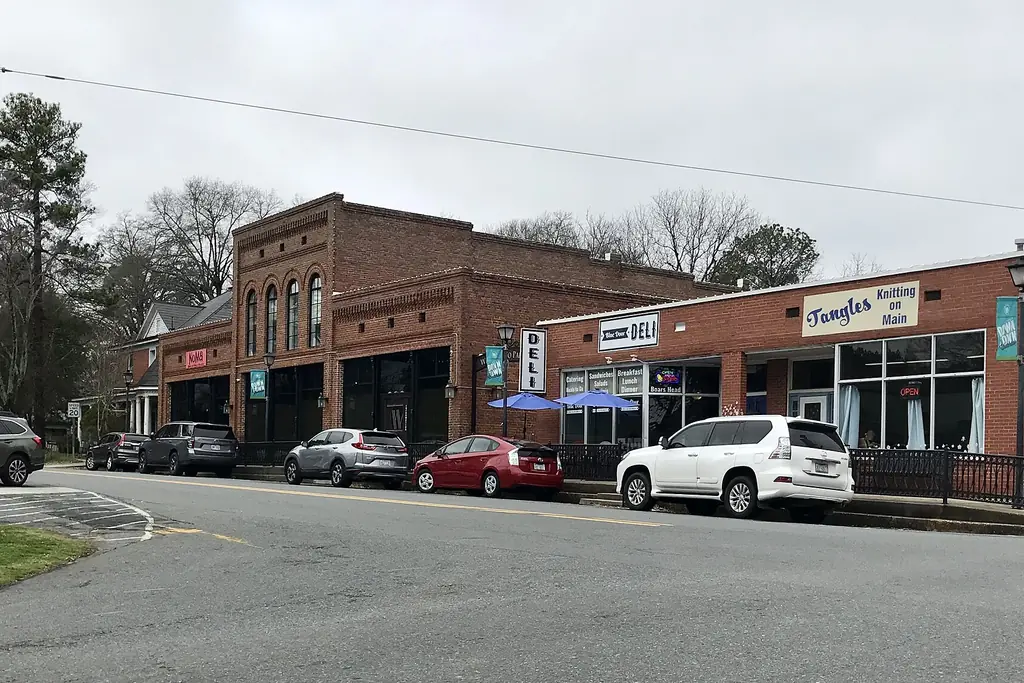
Waxhaw’s construction midpoint is 2010, a full decade later than Union County’s 2000 midpoint, and the typical owner moved in around 2016. Those two dates describe a town that built a large share of its current streets during the planned-community years and then filled them. Downtown along the railroad and the Museum of the Waxhaws are the older face of the same place. Cureton, Millbridge and Lawson are the newer one.
We broker these files from 128 S. Tryon Street in Charlotte, suite 1933. Company NMLS 2468711 identifies us as a North Carolina mortgage broker. You complete one application. Investors then receive that file, whether you are shopping a historic downtown property, a home in one of the named planned communities, a custom lot on well and septic, or a parcel whose mailbox says Waxhaw while the tax record says something else.
A housing stock that is a decade newer than the county
Census Reporter counts 22,275 residents. Homes occupied by their owners have a midpoint value of $549,400, above Union County’s owner-value midpoint of $417,300. Households here typically earn $131,894 versus $102,900 countywide. Ownership is the default: about 83 percent of households own, essentially matching the county’s 82 percent. Detached houses are 87 percent of the stock. About 79 percent of owners still carry financing, more than Union’s 70 percent share. Property taxes owners reported sit at a $3,906 midpoint, above Union’s $2,396, in line with higher values rather than a punitive town rate. Typical rent is $1,840.
Buyers often come for Union County schools and for more house than a south Charlotte or Ballantyne payment will buy. Commutes toward those job centers run along NC 16 and Providence Road.
Downtown, Cureton, Millbridge and Lawson
The railroad downtown is a small, walkable center with older houses near the tracks and the museum. Character is the draw. The age of those structures is what underwriters will study. Cureton, Millbridge and Lawson are a different product: planned streets, amenities, homeowners associations, and many houses sitting close to the 2026 conforming threshold published by FHFA ($832,750). Custom homes on larger lots outside those communities often rely on wells and septic rather than town water and sewer.
Toward the South Carolina line, some shoppers also compare Indian Land. That comparison changes the state, the closing customs and the tax math, so it is not a side-by-side of two Union County streets. Neighboring North Carolina guides include our Weddington page and the Union County overview.
When the mailbox and the tax card disagree
Waxhaw mailing addresses often fall outside town limits, in unincorporated Union County or even in a neighboring town. The 29-cent town levy applies only inside the limit. Two properties with the same mailing city can produce different tax bills once the parcel record is opened. We read that record before we quote escrow, and we do not treat the listing city’s name as the last word.
Inside town you pick up the published 2026-27 stack of $0.7242 (Union’s $0.4342 together with Waxhaw’s 29 cents). Beyond the line the municipal piece falls away. Each $100,000 of in-town value contributes about $724 a year, so $400,000 contributes about $2,897. Union County’s most recent reappraisal year, per DOR, is 2025. We still look for extra district charges on the bill and we still confirm the town-limit question before we treat last year’s coupon as a template for escrow.
Dues, transfer fees and a moderate town rate
The in-town stack of $0.7242 is moderate by Charlotte-metro standards and higher than Indian Trail’s unusually low total, which is the comparison many Union County shoppers make first. Yearly billing dates appear on our property-tax explainer.
In new planned communities, ask for the HOA budget, amenity fees and any transfer fee charged at closing. Some Waxhaw communities collect a transfer fee when a home sells, and that charge appears on the closing statement. Asking early keeps it from arriving as a surprise in the final week.
Prices that sit near the conforming cap
Many planned-community houses cluster near the 2026 conforming ceiling of $832,750, and larger or more custom homes exceed it. We compare a conforming quote with a jumbo quote whenever the budget sits close to that line, rather than assuming one or the other. Conventional financing handles most files under the cap. VA financing remains worth pricing for eligible veterans. FHA remains available but is less common at these values than in more affordable Union County towns.
Self-employed buyers can document income through bank-statement files when the return is a weak picture of household cash flow. Builder incentives appear in some newer phases; we quote the note on its own terms so a builder package stays optional.
A town of 22,000 whose houses are a decade newer than Union County's
Waxhaw’s published headcount is 22,275 on Census Reporter’s ACS compilation. Household earnings center on $131,894. The typical owned house is valued at $549,400. About 83 percent of households own, and the typical house dates to 2010, a full decade newer than Union County’s construction midpoint of 2000. Owners date their move-in to around 2016. Those four readings describe a town that absorbed a great deal of new housing in a short period, which is why so many streets still look and appraise like planned communities rather than like a 19th-century railroad village, even though the original downtown is exactly that.
The newer stock is also why many files are conventional and why jumbo questions appear when a planned-community price climbs toward the 2026 conforming cap of $832,750. It is not why every listing is simple. Downtown houses near the railroad and the Museum of the Waxhaws can be older, on smaller lots, and in need of a closer inspection. Cureton, Millbridge and Lawson are named communities with amenities, dues and, often, transfer fees. A house with a Waxhaw mailing label outside town limits drops the 29-cent municipal levy. Naming which of those four you mean is the first useful thing a caller can do.
The railroad downtown is a different product from Cureton or Millbridge
The original town grew around the railroad. The Museum of the Waxhaws sits in that older landscape and tells the longer story of the area, but it does not change a loan program. What does change the file is the house itself: an older downtown dwelling can need roof, HVAC or electrical attention during due diligence, while a house in Cureton, Millbridge or Lawson is more often a dues-and-transfer-fee conversation and a straightforward appraisal against recent sales inside the same community.
We do not treat those as interchangeable Waxhaw purchases. A downtown resale may want a renovation discussion or at least a conservative inspection period. A named-community purchase needs the association’s current budget, dues and any transfer fee in the worksheet before the letter goes out. An out-of-limit lot with a Waxhaw mailing address needs the tax card first, because the 29-cent town piece applies only inside town. Providence Road and the drive north toward Charlotte are a commute preference; they do not move the house into Mecklenburg County.
Indian Land is a different state, not a different Union County street
Shoppers who like Waxhaw’s newer housing often also tour Indian Land. That comparison crosses a state line. Closing customs, attorney practice and the way property taxes are calculated all change, and those differences belong on our Indian Land and Lancaster County pages rather than in a Union County town article. What we can do on the first call is tell you, honestly, that the two worksheets will not look alike even if the houses do.
Inside Union County the fairer comparisons are Indian Trail, Weddington, Marvin and Monroe, each of which has its own levy and its own housing mix. Waxhaw’s in-town stack for 2026-27 is 72.42 cents, built from Union’s $0.4342 and the town’s 29 cents. That is higher than some neighboring Union towns and still different from a Charlotte city bill. We will put the in-town stack, or the out-of-limit stack, on the letter that matches the parcel you are actually bidding on.
One worksheet for downtown, a planned street or an out-of-limit lot
We begin by identifying whether you are shopping downtown, a named planned community, a custom well-and-septic lot, or a house whose mailing city may not match the tax jurisdiction. The monthly worksheet already applies the $0.7242 in-town total when the lot sits inside Waxhaw, plus any known association dues and transfer fees. When the income and asset file is complete we produce a letter meant to withstand a listing agent’s review.
The statewide closing sequence is described in our purchase guide. After ratification we choose an investor suited to a planned-community appraisal or a well-and-septic custom lot, then lock on a timeline that respects due diligence. The closing attorney records in Union County. Homeowners considering a refinance have the Charlotte overview.
Waxhaw purchase reviews
Client comments displayed here are public Google reviews, printed without our edits.
Waxhaw numbers and their publishers
Census Reporter compiled the 2020-2024 ACS estimates cited on this page, including a $549,400 owner-value midpoint, 22,275 residents, income of $131,894, 83 percent ownership, a 2010 construction midpoint, detached share (87 percent), financed-owner share (79 percent), taxes paid of $3,906, rent of $1,840 and a 2016 move-in year, shown against the Union County figures. DOR’s 2026-27 publication shows Union’s $0.4342, Waxhaw’s 29 cents and the $0.7242 in-town total, and DOR lists 2025 as Union County’s most recent reappraisal. The $2,897 example applies that stack to an in-town tax value of $400,000. Downtown along the railroad, the Museum of the Waxhaws, Cureton, Millbridge, Lawson, wells and septic on custom lots, NC 16 and Providence Road toward Ballantyne, Union County Public Schools, HOA transfer fees in some planned communities, and the warning that many Waxhaw mailing addresses sit outside town limits were part of the earlier live page.
In-town versus out-of-limit monthly cost
Apply the $0.7242 rates to an in-town tax value of $400,000 and the yearly tax is about $2,897. Plenty of purchases sit nearer the $549,400 owner midpoint, which raises the dollar bill above that illustration. Include insurance priced for that house, association dues and any transfer fee the community charges at closing, and money set aside for well or septic maintenance on custom lots off town utilities. Flood questions still belong on creek-adjacent parcels; use FEMA’s maps for the specific lot.
Equity conversations for 2016-era Waxhaw owners
Owners who arrived around 2016 bought into a fast-growing planned-community market and may now hold a larger cushion than the original price implies, especially after Union’s 2025 reappraisal. If you want cash while keeping the current first mortgage, use the Charlotte HELOC guide for a side-by-side of a line of credit and a lump-sum second. If the next purchase has to close first, that is a bridge conversation.
1st Advantage Mortgage Broker LLC is a Mortgage Broker, not a lender. Company NMLS #2468711 (NMLS Consumer Access), licensed as a mortgage broker by the North Carolina Commissioner of Banks. Equal Housing Opportunity. 1st Advantage Mortgage is not a government agency and is not affiliated with HUD, FHA, VA, USDA or any city or county. This page is general information, not an offer or commitment to lend. All loans are subject to credit approval, property appraisal and program eligibility, and program availability can change. Local statistics are estimates from the sources listed.